
TL;DR
Mastering Tables 2 to 9 is a 10-day challenge for children aged 6-7.
It combines a daily video, a test worksheet and tracker, and 10 live sessions. The page lists 7:00 to 7:30 pm; confirm current batch timing and timezone.
Friday is a revision game, and a WhatsApp group keeps the Zoom link and updates in one place.
The page advertises a free 30-minute assessment call and a money-back guarantee. Confirm availability and full conditions directly with the academy.
Check current fees and batch dates with the academy before you enrol.
Why tables still matter
Every parent has heard it: "Do we really need tables when there is a calculator?" Yes. Tables are the speed layer under multiplication, division, fractions and later algebra. A child who knows them moves through school maths with ease. A child who does not has to stop and count every time, and that slows down every other topic.
At age 6 or 7, the aim is not pressure. It is a friendly start. The Mastering Tables 2 to 9 challenge at Sandhya Bajaj Academy is built for exactly this age and this range.
The challenge at a glance
| Feature | What the program page says |
|---|---|
| Age group | Children aged 6-7 |
| Tables covered | 2 to 9 |
| Length | 10 days |
| Live sessions | 10 sessions; the page lists 7:00 to 7:30 pm. Confirm the current batch time and timezone. |
| Daily material | A video, a test worksheet and a tracker |
| Friday | A revision game |
| Communication | A WhatsApp group with the Zoom link pinned |
| Before you join | A free 30-minute assessment call |
| Assurance | A stated money-back guarantee |
Fees and batch dates change, so please confirm them with the academy.
How the ten days are organised
Join the group. After enrolment, parents are added to a WhatsApp group where the Zoom link is pinned, so nobody hunts for it at 7 pm.
Watch the daily video. Each day brings a short lesson on how to learn that day's tables.
Do the test worksheet. The child practises and tests themselves, and records progress on a tracker.
Attend the live session. Thirty minutes, with the coach, in the evening.
Play the Friday game. Everything is revised through a game, which turns revision into fun.
Rest on the weekend. Children need a break, and so do parents.
Why short live sessions suit small children
A seven year old's attention is limited. Thirty minutes is long enough to learn something and short enough to stay interested. The evening slot also means school is over, homework is mostly done, and the child can focus. Short and regular beats long and rare, which is why a 10-day format with daily contact tends to build habit better than a single weekend workshop.
The tracker: a quiet confidence builder
Young children love seeing progress. A tracker where they tick off tables they have mastered turns an abstract goal into something visible. Parents can stick it on a wall or the fridge. When a child sees five tables ticked, the sixth stops looking scary.
Which tables, in what spirit
| Tables | Parent tip |
|---|---|
| 2, 5 and 10 | Link to skip counting, coins and clock face. Most children enjoy these first. |
| 3 and 4 | Link 4 to doubling the 2 table. Link 3 to groups of three, like wheels on tricycles. |
| 6, 7, 8 and 9 | The hardest group. Short daily practice and games work better than long sessions. |
How young children actually learn tables
Children aged 6 and 7 learn through the senses. They count objects, move their bodies, sing, and play. Abstract rows of numbers on a page are the least natural way to meet tables, and yet that is how most of us were taught. When tables are linked to something the child can touch, hear or see, the memory is stronger and the stress is lower.
Three ideas help at this age. The first is repetition in small doses: five minutes, several times a week. The second is pattern: every table has a shape, and children enjoy spotting it. The third is play: a game turns practice into something the child asks for.
Spotting patterns in each table
| Table | A pattern a child can notice |
|---|---|
| 2 | All answers are even, and each is the number doubled |
| 3 | Notice repeated groups of three and practise adding three mentally |
| 4 | Double the 2 table answer |
| 5 | Answers end in 5 or 0, like the minute marks on a clock |
| 6 | Add the 5 table answer to the number itself |
| 7 | Often the hardest. Use short rhymes and daily repetition |
| 8 | Double the 4 table answer |
| 9 | The digits of each answer add up to 9 for the first ten answers, and the tens digit goes up as the units digit goes down |
These patterns are general maths facts and a good conversation starter. The academy's own methods are taught inside the program, so use these as warm-up play at home.
A gentle ten-day rhythm for the family
The live sessions happen each evening, so the rest of the day can be light. This sample rhythm is a parent's idea, not an academy schedule.
| Day | Family focus |
|---|---|
| 1 | Set up the tracker on a wall. Make it feel like a game board |
| 2 | Notice patterns in the easiest tables and say them aloud |
| 3 | Use household objects to show groups |
| 4 | Ask three quick questions at mealtime |
| 5 | Review the week, then enjoy the Friday game |
| 6-7 | Rest. Only a light, playful mention of tables |
| 8 | Pick the two tables that feel hardest and practise them in a game |
| 9 | Let your child quiz you |
| 10 | Look back at the tracker and celebrate the progress |
Common mistakes parents make
Drilling for too long. A tired child learns less and dislikes tables more.
Only practising in sequence. A child who knows 3, 6, 9, 12 in order may not know 3 x 4 when asked cold.
Using fear as a motivator. Anxiety blocks recall, which is the opposite of what you want.
Skipping the hard tables. The 6, 7 and 8 tables need the most care, so give them extra short sessions.
Comparing children. Every child has a different pace, especially at 6 and 7.
Expecting instant results. Tables settle through repetition across days and weeks.
What to do when your child gets frustrated
Pause. Offer water or a stretch.
Go back to a table the child knows well and win something first.
Name the feeling: "This one is tricky, and that is okay."
Try a different approach, such as a picture or a game.
End on a success, even a small one.
The coach in the live session sees many children in the same state, and can guide you. Share what you notice.
Games to play at home
Table bingo. Draw a grid of answers and call out questions.
Hopscotch tables. Write numbers on the floor and hop to the answer.
Beat the clock. Time five questions and try to beat the time tomorrow.
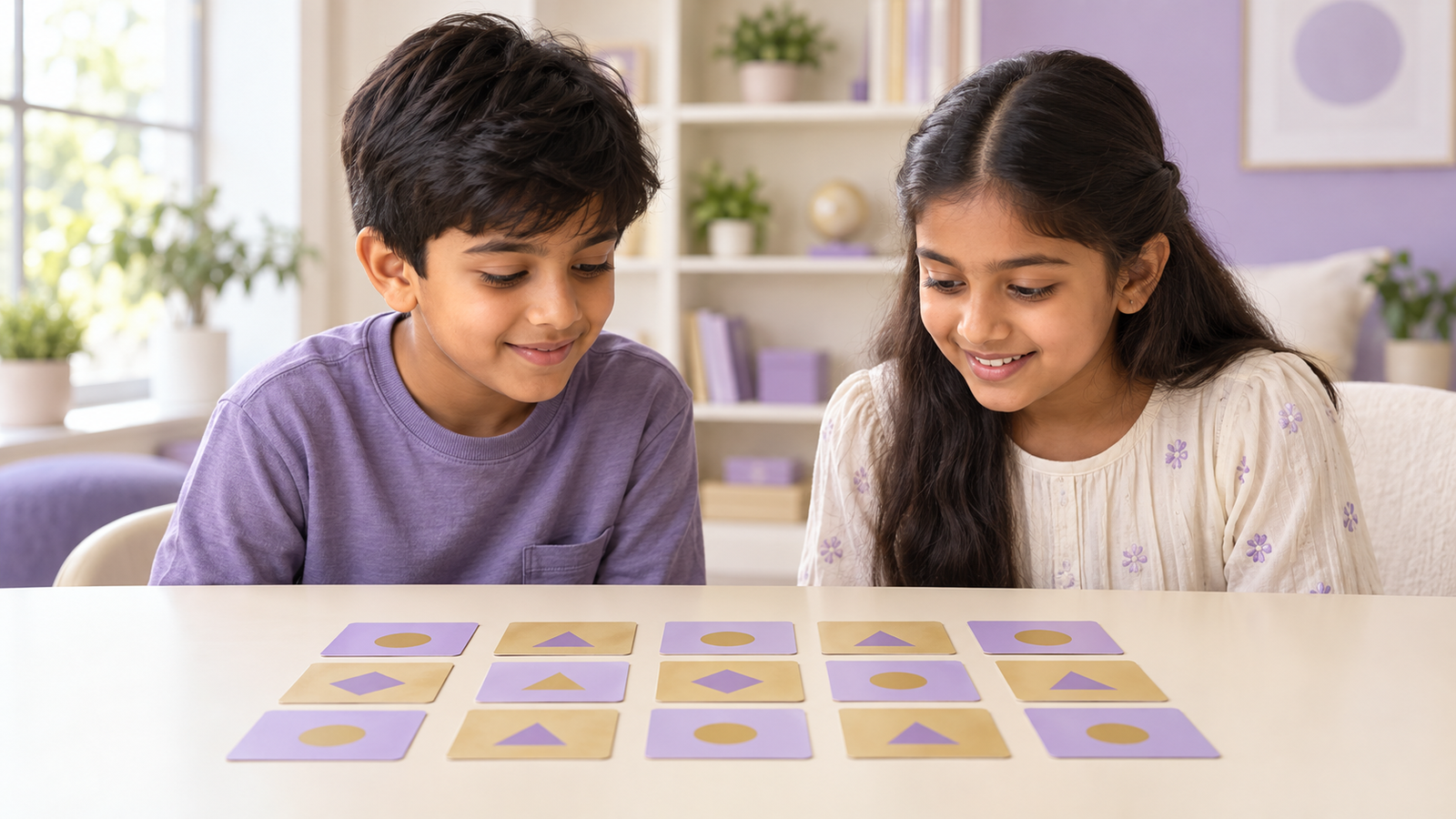
Memory pairs. Make cards with questions and answers, and match them.
Story tables. "Four boxes with six mangoes each. How many mangoes?"
Ladder game. Draw a ladder, climb one step for each correct answer.
Linking tables to school work
Tell your child's teacher that you are doing a tables challenge. Teachers often appreciate it, and may notice changes in class participation. Ask the teacher which tables are being covered at school this term, and align your home practice with them.
What success looks like
Success is not only a perfect score. It is a child who says "I know this one", who tries before asking for help, who looks forward to the Friday game, and who sees the tracker fill up. Those signs matter as much as the number of tables learned.
Who it suits
Children aged 6-7 who are meeting tables in school for the first time.
Children who know a few tables but mix them up.
Children who panic when asked a table fact aloud.
Parents who want a structured plan instead of nightly arguments over homework.
Ten ways to support learning at home
Practise for five minutes, once or twice a day, not for an hour once a week.
Sing or chant tables during bath time or a walk.
Use real objects: buttons, spoons, steps on a staircase.
Ask table questions in random order, not only in sequence.
Play card games where the child multiplies two cards.
Let your child test you, and make a mistake sometimes.
Praise the effort and the method, not only the speed.
Keep the tracker visible.
Avoid comparing with siblings or classmates.
Stop while it is still fun.
What to ask in the assessment call
The free 30-minute call is a chance to check fit before you commit. You may want to ask about your child's current level, the best time slot, how the coach handles a shy child, and what practice is expected each day. Ask also what the money-back guarantee covers and how to claim it, so there are no surprises.
After the ten days
Once your child has the 2 to 9 tables, the natural next steps are division and larger tables. See Mastering Division Facts 2 to 99 and Mastering Tables 12 to 99. For a longer, one-to-one path across all four operators, see Vedic Math Basic.
Frequently asked questions
What age is Mastering Tables 2 to 9 for?
Children aged 6-7.
How long is it?
The page describes a ten-day challenge with sessions from 7:00 to 7:30 pm. Confirm the current batch schedule and timezone before enrolling.
What does my child need?
A device for Zoom, a quiet spot, and a pen and paper for the worksheet.
How do I get the Zoom link?
It is pinned in the WhatsApp group created for the batch.
Is there a trial?
The page offers a free 30-minute assessment call before you decide, and states a money-back guarantee. Please read the exact terms with the academy.
How do I enrol?
Use the button on the program page or write through the contact page.
The bottom line
Tables are a skill, and a skill is built with small daily steps. Ten days of videos, worksheets, live sessions and a Friday game give a young child a friendly route into 2 to 9. Read more about the founder on the About page, or browse the academy blog.